Linguagem :

português
português
Cold-Air Scent Diffusion: Atomization and Room Coverage
Oct 16, 2026
Cold-air scent diffusion uses moving air to disperse a compatible fragrance liquid without a heated evaporation stage. In waterless equipment, the operator does not add a water reservoir to dilute the oil. These descriptions explain the delivery method, but they do not establish how evenly a particular room will be scented.
A fine spray at the outlet and a balanced fragrance experience across a building are different outcomes. Between them lie the oil formulation, operating cycle, installation position, room geometry, and ventilation conditions.
Understanding that distinction helps hotel operators, facilities teams, distributors, and commercial designers interpret equipment specifications more accurately. It also explains why increasing intensity is not always the right response to an uneven scent.
Cold-air scent diffusion is easier to understand when divided into three stages.
| Stage | What happens | What it does not prove |
|---|---|---|
| Atomization | Liquid is broken into droplets at the atomizer | Every part of a room receives the same amount |
| Distribution | Released fragrance moves through the surrounding air | Every occupant experiences the same intensity |
| Perception | People notice and interpret the fragrance | Their impressions are a direct measurement of concentration |
A problem at one stage should not automatically be treated as a problem at another. A unit can produce fragrance while its position leaves a side room poorly served. Conversely, a familiar smell may seem less noticeable to an employee without demonstrating that output has stopped.
For practical evaluation, record equipment behavior and observations in the occupied space separately. Both matter, but they answer different questions.
In two-fluid atomization, a gas stream interacts with a liquid stream to create droplets. For scent equipment, the two fluids are typically air and fragrance liquid; the term does not mean two fragrance oils are mixed together.
Industrial nozzle manufacturer BETE explains air atomization as combining liquid with compressed air or gas, with internal or external mixing depending on nozzle design. This establishes the general engineering principle, not the precise internal construction of every fragrance device.
For cold-air scent diffusion, the pump, liquid path, and atomizer must work as a compatible system. A general description of the technology cannot establish a specific model’s droplet distribution, consumption, or coverage.
“Cold air” also does not mean refrigerated air. The term describes operation without using a heated evaporation stage; it is not a cooling function for the room.
A spray contains a range of droplet sizes. A single advertised number may describe a median, another average, or a particular measurement condition. Those interpretations are not interchangeable.
Spraying Systems Co. explains that droplet distribution and liquid properties matter in atomization. Its guidance notes that viscosity and surface tension influence the energy needed to break up a liquid.
When reviewing cold-air scent diffusion claims, ask which liquid was tested, which operating conditions were used, and what the reported number represents. A result measured with water or a different formulation should not automatically be treated as the result for your fragrance oil.
Terms such as “nano” or “micro” are not substitutes for a defined measurement. Without a model-specific report, avoid converting a marketing phrase into a precise performance specification.
In cold-air scent diffusion, waterless normally describes the operating arrangement: fragrance is supplied without the user filling a separate water tank.
It does not establish that the liquid is pure essential oil, that all formulations are interchangeable, or that the emitted material contains no droplets. Atomization breaks up liquid; it is different from simply converting all liquid into a gas.
Similarly, “dry mist” should not be interpreted as a guarantee of zero surface deposition under every condition. Oil choice, output, outlet clearance, and nearby surfaces still deserve attention during an installation trial.
The relevant question is whether the specified formulation performs appropriately in the supplied equipment. Confirm compatibility instead of adding water, changing dilution, or substituting oil based only on a similar fragrance name.

Cold-air scent diffusion introduces fragrance at a location; the room then influences where that fragrance travels.
Supply and return air paths, open doors, partitions, connected corridors, and extraction can affect distribution. A screen may divide a showroom visually while leaving air movement connected. A recessed corner may behave differently from an open central area.
Consider an illustrative showroom with an open display floor and a screened consultation alcove. If fragrance is strong near the outlet and weak in the alcove, increasing output might intensify the first location without resolving the difference.
This is a hypothetical explanation, not a measured DANQ installation. It shows why placement and airflow should be examined before changing output. The aim is appropriate performance at relevant locations, rather than a stronger impression immediately beside the unit.
Cold-air scent diffusion specifications often describe coverage as a volume. Cubic meters and square meters are different measurements.
For a simple rectangular room:
Room volume = floor area × ceiling height.
A 200 m² space with a 3 m ceiling contains approximately 600 m³. The same floor area with a 6 m ceiling contains approximately 1,200 m³—twice the volume.
This geometric example does not mean oil consumption must double, or that one particular device will cover either room. Ventilation, layout, operating conditions, and the required sensory result remain relevant.
Likewise, an “up to” coverage figure does not establish performance in every room below that volume. Use it as an initial reference, then assess the actual application. For irregular spaces or several connected zones, provide a layout rather than reducing everything to one floor-area number.
Cold-air scent diffusion may use alternating working and pause periods. The proportion of time spent operating is called the duty cycle.
Duty cycle = working time ÷ (working time + pause time).
As a calculation example, 30 seconds working by 90 seconds paused gives a 25% duty cycle. Over an uninterrupted 12-hour scheduled window, that corresponds to three hours of accumulated working time.
These are illustrative values, not recommended settings or a Q3000PRO consumption claim. Startup behavior, actual output while running, the fragrance formulation, and other operating conditions can affect consumption.
A 25% duty cycle also does not mean 25% perceived fragrance intensity. The room retains and exchanges air while the device cycles, so sensory response cannot be read directly from that percentage.
A larger reservoir can reduce refill frequency, but bottle size does not establish the hourly rate at which oil is used.
For cold-air scent diffusion projects, consumption information is more useful when it names the oil, settings, operating schedule, and measurement period. Compare like-for-like conditions rather than assuming that the same nominal intensity label produces the same consumption everywhere.
A site record can include starting and ending oil quantity, operating hours, and any refills or interruptions. Do not convert mass to volume without an appropriate density value, and do not infer an exact remaining runtime from an approximate bottle-level observation.
This distinction supports replenishment planning without promising a refill interval that has not been measured.
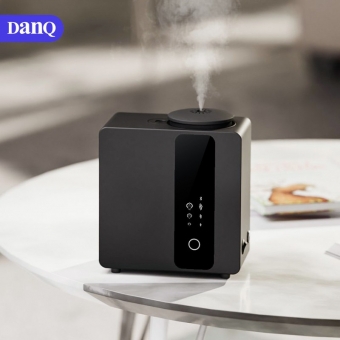
The official DANQ Q3000PRO product page lists a 1,000 ml bottle, nominal coverage up to 4,000 m³, and standalone, wall-mounted, and HVAC installation options. Its specification table separates Bluetooth plus touch-screen and Wi-Fi plus touch-screen versions.
These details describe a product configuration and its stated application range. They do not establish identical fragrance intensity throughout any 4,000 m³ building, a fixed refill interval, or a particular droplet-size measurement.
When applying cold-air scent diffusion to a project, confirm the current configuration and evaluate the oil, installation, and operating pattern together. The manufacturer’s coverage statement itself notes that actual results vary with site conditions.

A compact record makes cold-air scent diffusion observations easier to interpret:
Room dimensions and connected areas.
Approved oil and equipment configuration.
Installation position and outlet clearance.
Scheduled hours and working/pause settings.
Ventilation state and door conditions.
Observations at several occupied locations and times.
Change one relevant factor at a time where practical. Record the adjustment and check whether it improves the intended area without creating an intrusive concentration elsewhere. Follow the supplied instructions for installation and servicing.
For an initial technical discussion, send DANQ your layout and operating conditions. Clear site information makes product advice more specific.
It is intended to deliver fragrance, not provide room cooling or humidity control. “Cold air” and “waterless” describe aspects of the delivery method; they should not be interpreted as HVAC performance claims.
Do not assume compatibility. Confirm the intended formulation with the equipment supplier. Similar scent names do not establish similar physical properties or equivalent behavior in an atomizer.
No. The appearance of a plume is not a measurement of fragrance distribution across occupied areas. Assess the required locations during representative operating conditions instead of judging performance only at the outlet.
Room volume, air movement, doors, partitions, installation position, and the fragrance formulation can differ. Copying settings creates a starting point, not a confirmed result. Recheck the application at each location.
Cold-air scent diffusion combines liquid delivery, atomization, and room-air distribution. A useful specification explains each part without treating droplet size, bottle capacity, coverage, and perceived intensity as the same measurement.
DANQ has manufactured scent equipment since 2011 and supports OEM/ODM projects. To explore the application described here, review the Q3000PRO configuration and prepare your layout, ceiling height, ventilation information, and operating schedule.
Contact DANQ for a Q3000PRO application review, quotation, and sample options. The next step is to confirm the equipment and fragrance combination against the actual space.

fabricante profissional, desde 2009.
espalhando o perfume do amor por todo o mundo.


Guangzhou DANQ Environmental Technology Co.,LTD